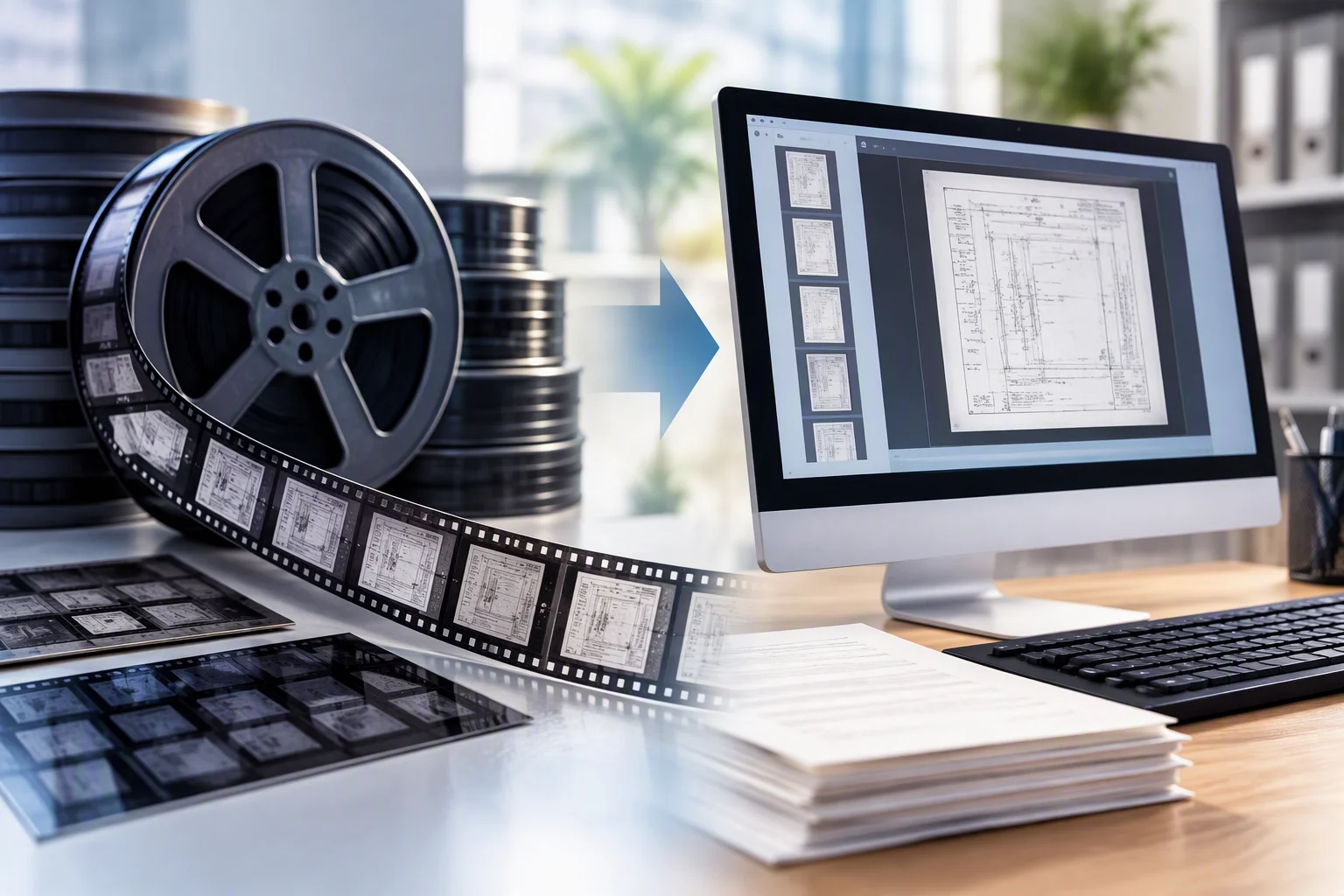
World leader in digital-to-film quality and silver duplication of 16mm, 35mm, and 105mm microfilm
Our eBeam Film recorders process over 2 million images a year!
Our Microfilm & Microfiche Scanning Services
Archival Film Processing
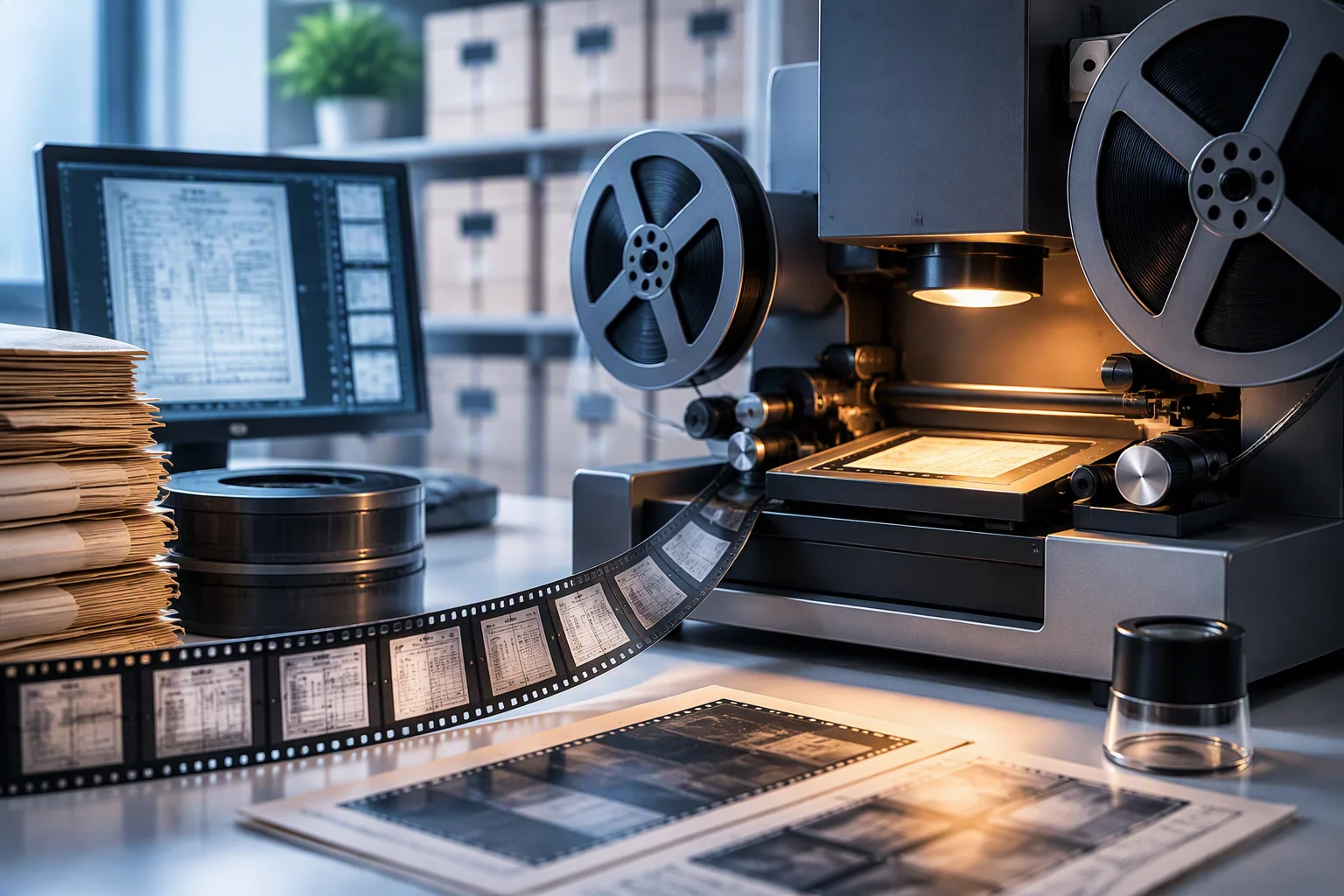
We have worked with NJ and CT state archivists and prestigious universities to set the microfilm industry standards for film quality. We provide our federal, state and local government and commercial customers with bi-tonal and grayscale high-resolution images (200, 300, 400, 600 dpi) on 16mm, 35mm and 105mm archival microfilm, as well as 5.5’ and 9” for satellite recordings. Digital files are transferred from CD’s, DVD’s magnetic tape, magnetic disks, and internet servers for conversion to microimages on film. Our film processing facility is equipped with roll-to-roll inspection viewers, stereo microscopes, light boxes, X-Y coordinating measuring equipment, and densitometers.
Consistent Security
Film recorders connected to a local area network. IDI utilizes it’s advanced Production Control & Workflow System (PCWS). This manages the production of microfilm projects from receipt to shipment. Scanned images are transmitted to IDI via secure FTP or CD or hard drive. All media is labeled with a media number and inventoried in our Work Order Tracking System. The media will be stored and segregated in our records vault while awaiting production.
Careful Handling
All archival film is wound on certified archival plastic reels and stored in certified archival plastic or acid free boxes. Special care is taken to handle the film with lint free gloves at all stages of the production process. IDI maintains control procedures to ensure the quality and consistency of the output film.
Output File Types
Digital input data to the eBeam Film recorders can be in raster formats such as TIFF (CCITT Group 3, 4, RLE, uncompressed), PostScript, PDF, grayscale or alphanumeric formats (ASCII or EBCDIC).
Microfilm & Microfiche Scanning for Industries
Legal, Finance, Libraries
Efficient Document Retrieval
Allows for quick, keyword-based searches
Ideal For
Frequently retrieving archival records
Healthcare, Finance, Insurance
Enhanced Data Security
Encrypted and backed up, protecting sensitive data from theft, loss, or corruption.
Ideal For
Handling confidential information
Education
Reduced Physical Storage Costs
Converting eliminates the need for bulky filing cabinets and climate-controlled storage environments.
Ideal For
Large historical archives, universities and colleges, and utility companies
Audits, Non-Profits, Government
Compliance & Audit Ready
Digital files can be organized and indexed for easy audit trails and to meet legal documentation standards.
Ideal For
Tax and grant reporting obligations
Technology & Sciences
Remote Access
Digitized records can be accessed by authorized personnel anywhere, anytime.
Ideal For
Distributed teams in labs and firms, academic research, news/media
Museums, Archives, Historical Societies
Historical Preservation
Digital conversion protects irreplaceable historical or cultural documents from degradation.
Ideal For
Collections with rare and fragile materials
Converting Microfilm & Microfiche to a digital format is highly beneficial.
Microfilm was first introduced in the early 20th century and became widely used in the 1930s. Libraries, government agencies, and businesses quickly adopted it as a solution for storing vast amounts of information in a compact format. Microfilm scanning is the process of converting microfilm or microfiche—a type of flat film containing miniature photographs of documents—into digital formats. This process preserves important historical, legal, or institutional documents and enables easier access, sharing, and archiving without degradation of the original data. The resulting digital files are often indexed and searchable, making retrieval fast and efficient compared to traditional methods of reading microfilm through analog viewers.

Physical Deterioration & Preservation
Digitally scanning your microfilm is one of the smartest moves organizations and institutions can make to preserve valuable records while improving accessibility and efficiency. Microfilm, while durable, is still susceptible to environmental damage like humidity, mold, and physical deterioration over time. Digital scanning ensures that your documents are stored in formats that can be backed up, duplicated, and protected indefinitely—far outlasting even the best-stored reels of film.

Expanding Accessibility
Once scanned, microfilm documents can be processed with Optical Character Recognition (OCR), making them text-searchable. This means users can quickly locate the exact page, name, or data point they need without manually scrolling through reels—saving countless hours and significantly improving research workflows.

Storage Constraints
Microfilm requires physical storage, often in specialized climate-controlled environments. By converting microfilm to digital formats, organizations can eliminate bulky cabinets and storage rooms, freeing up valuable office or archive space that can be repurposed for more productive uses.

Disaster Recovery & Backup
In today’s world, disaster recovery and backup capabilities are non-negotiable. Natural disasters, fires, or equipment failures can wipe out entire physical archives. Digital formats can be securely backed up to the cloud or off-site servers, ensuring that no matter what happens, your historical records remain safe and recoverable.

Standards Compliance
Many industries have shifted to digital-first documentation and require digital access for audits, records management, or legal compliance. Digitally scanned microfilm can be seamlessly integrated into document management systems (DMS) and accessed remotely, meeting both regulatory and operational expectations.
FAQs
Document Scanning and Digitization Services: We work with almost every type of document. This includes books, correspondence, meeting minutes, newsletters, newspapers, magazines, and other common materials. We also handle more specialized items such as maps, architectural drawings, microfilm and microfiche, and a wide range of multimedia including photographs, slides, negatives, 8mm and 16mm film, VHS, Mini DV, audio cassettes, and reel‑to‑reel recordings. If it needs to be digitized, we can almost always accommodate it.
We provide files in whatever format best fits your workflow. The most common are searchable PDFs, TIFFs, and JPEGs. We can also provide data in XML or CSV formats for easy import into your existing Document Management System (DMS).
Yes. We offer “Scan-on-Demand” services. If you urgently need a file that is currently in our queue, our team will locate it, scan it immediately, and securely email or upload it to you within hours.
We offer three options: we can securely return your documents in their original order, provide long-term archival storage, or perform certified shredding with a Certificate of Destruction once you have verified your digital files.
Absolutely. Security is our top priority. Our facilities follow strict Chain of Custody protocols, and our staff is background-checked. We maintain compliance with HIPAA and other data privacy regulations to ensure your sensitive information is protected from the moment it leaves your office.
OCR (Optical Character Recognition) is a technology that converts the text in a digital image into machine-readable data. Every document we scan is processed with OCR, allowing you to search your entire archive by keywords, names, or invoice numbers in seconds.
Yes. IDI specializes in converting legacy media like 16mm/35mm microfilm and microfiche into high-resolution digital formats. We use “Ribbon Scanning” technology to ensure no frames are missed and to improve the legibility of old or scratched film.